

What to film when your product lives on a screen.
Software is hard to point a camera at. The people who build it, the problem it solves and the hardware it runs on are not. Here is how we would plan a month of video for a tech company.

The first instinct at a tech company is to post the product: a screen recording, a feature list, a new button. It makes sense, because the product is what the team looks at all day. On its own, though, it makes a thin post. A screen recording shows what the product does and nothing about why anyone should care.
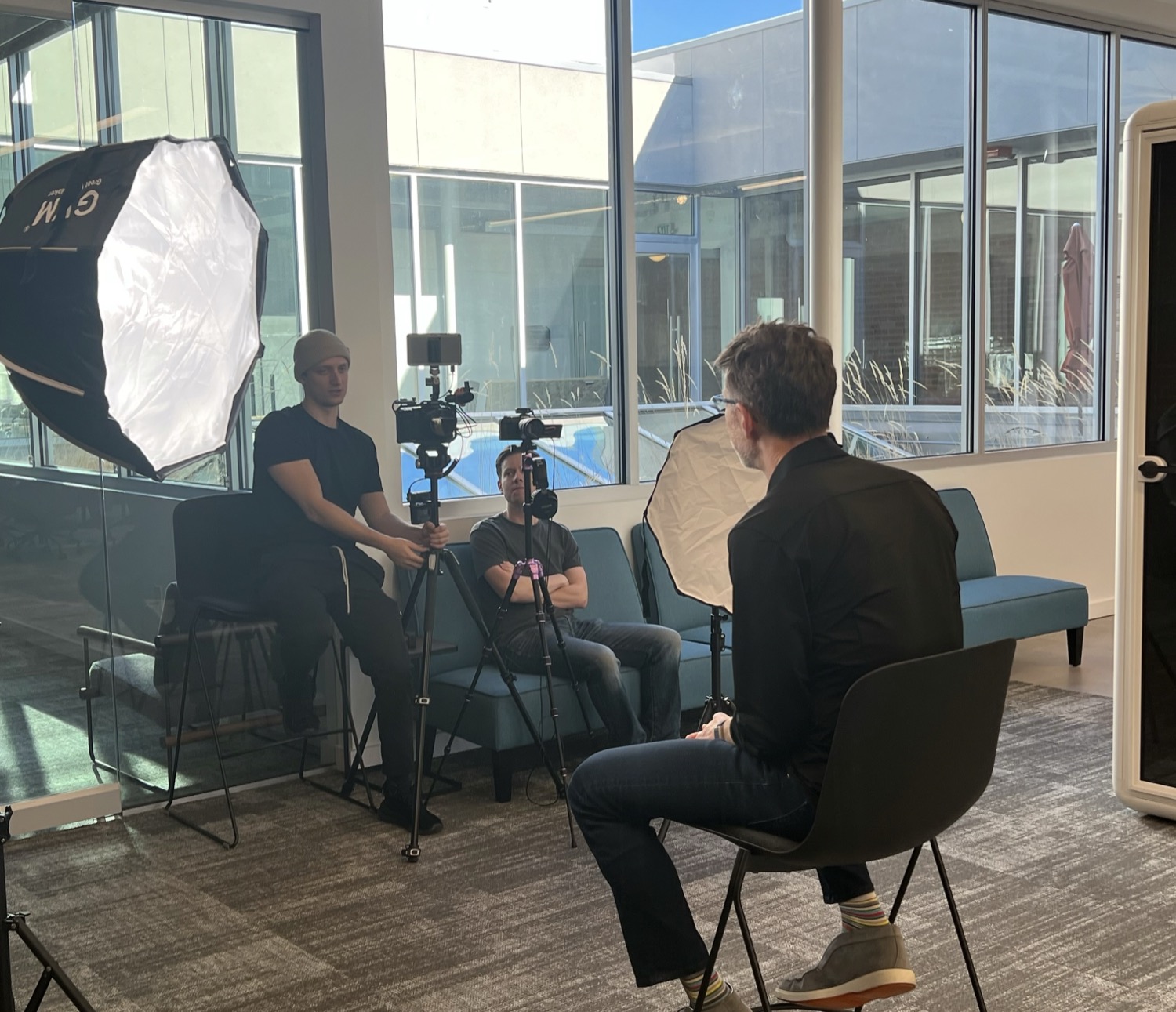
Our monthly plan for a technology or medical technology company would rest on a single filming day where the work happens, in the office or the lab: the founders and engineers, the product, and whatever launch or demo is coming up. The edit turns it into 30 clips for the month. Below is how we would approach it.
Film the problem before the product.
Every product exists because something was hard. A clinic losing afternoons to paperwork, a team buried in spreadsheets, a device that needed to be smaller. That problem is the part a viewer recognizes, so it comes first. The product arrives as the answer.
In the strategy meeting, we would work out with you the three or four problems your product solves, in the words a customer would use. Each one becomes a thread for the month, told over several posts:
- The problem A founder names it, and says why it was worth building a company around.
- The approach An engineer shows how the team went at it, at the whiteboard or the bench.
- The product The part of the product that answers it, shown with motion graphics or animation.
- The questions What customers ask about it, answered on camera by the person who knows.
The people who build it.
A tech company is a group of people who know something the viewer doesn't. On camera, that is an advantage. We record interviews with founders, engineers, designers and the people who talk to customers, and cut each one into clips that make a single point in plain words.
- What problem did you start this company to solve?
- What was the hardest part to build?
- What does a customer's first week with the product look like?
- What are you working on that you can talk about?
Not everyone on the team wants to be on camera, and not everyone needs to be. One or two people who explain well can carry a month, and the rest of the team appears in the B-roll.
The office and the lab fill the rest of the frame: whiteboards, prototypes, a stand-up meeting, a test bench. They show a customer, an investor or a future hire the room where the product gets made.
When the product is on a screen.
Software can still be shown. It just needs help. In the edit, every cut carries motion graphics and subtitles, so a short, clean screen capture can sit inside a clip with a label pointing at the one thing that matters.
When your team records a capture for us, a few habits help: full resolution, a clean account, notifications off, and a cursor that moves slowly enough to follow.
When the interface needs more than that, animation can carry it: product loops, logo moments, graphics placed into filmed shots. Tess designs it in house. It is priced on its own, quoted per project on top of the plan, and never bundled into one.
Hardware and medical devices up close.
Hardware is the opposite problem: the product is physical, and small details carry the story. We film a device close, showing the detail, the build, and how a hand holds and uses it. For medical technology, that means the device in the setting it is made for, with the people who use it explaining what it changes.
Close work is slow work. A device filmed well needs a clean surface, controlled light and time to move around it, so we would give the product its own block of the filming day instead of fitting it between interviews.
Medical technology has more to get right on screen. Claims, terms and anything a clinician says should read exactly as your team intends, which is why the approval step matters: nothing is published until your team has signed off on the plan and on each post. Still photos of the device have their own page, product photography, shot at our studio in Oakland Park.
Launches and the month around them.
The month's filming day can be the launch itself, a demo day, or a talk your founder gives at a conference, so the feed is busiest in the week it matters most. A launch can also be planned from further back. We would put the filming day in the weeks before it, while the work is still happening, and hold those clips until the day it ships. Launch week then has a story behind it, not a single announcement.
Either way, the filming day becomes 30 edited clips, posted every day on every platform from a plan you approve. We reply to comments and DMs, and a message that reads like a sales lead goes to your team. A report closes the month, and the next strategy meeting starts from what people watched and asked about.
A tech company is already full of people explaining the product to each other. Filming them once a month, and animating what a camera can't see, is how the product gets explained to everyone else. See how the plan works for technology companies.
Common questions.
What you build, explained by the people who build it.
We come to your office or lab for a day each month and film the team, the product and the dates on your calendar. What lives on a screen can be animated. The editing, the posting and the accounts are ours.
More from the blog.
Let's film your company.
Tell us what your company does and what happens there on a schedule. We'll come back with what a month of content could look like.